EU–Latin America Academic Synergies
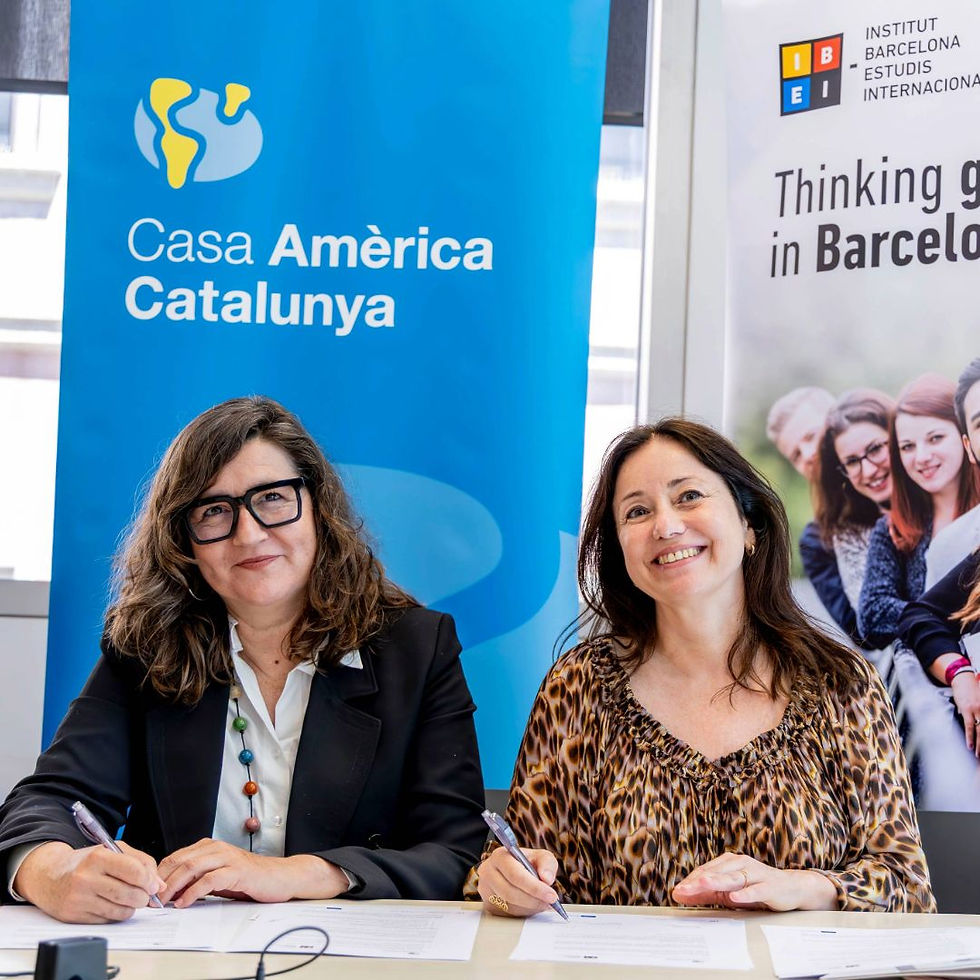


A new strategic partnership for Casa Amèrica Catalunya, IBEI, EU-LAS Network and the LAC-EU Doctoral Network


Highlights of the Third EULAS International Conference: Countering Populism: Advancing Liberal Democracy and Human Rights across Europe and Latin America and the Caribbean
16/11/26, 10:00
From November 5 to 7, the Third EULAS International Conference took place in Quito, Ecuador. Hosted by Universidad San Francisco de Quito (USFQ), the event, entitled “Countering Populism: Advancing Liberal Democracy and Human Rights across Europe and Latin America and the Caribbean,” brought together scholars and policy experts working on democracy and populism from across Europe, Latin America, and the Caribbean.
Over three days, participants discussed a wide range of topics, including the resilience of liberal democracy, the effectiveness of rule-of-law promotion, new varieties of populism, political polarisation in the EU and beyond, election observation and the integrity of democratic processes, regionalism and regional democratic mechanisms and clauses, the relationship between democratic backsliding and AI, and populist narratives, identity construction, and stereotypes. In total, nearly 90 papers were presented across 21 panels. The programme also featured four roundtables on issues including the EU–LAC partnership and academic freedom, two workshops on teaching, research, and funding opportunities between Europe and Latin America, and six student panels showcasing the work and findings of emerging researchers.
The opening day welcomed participants from across the network’s 24 partner institutions, as well as external attendees. Following the inaugural session, two workshops were held in USFQ’s Casa Branca Theater, focusing on teaching initiatives and research funding opportunities within the EU–LAC framework.
The second day began with welcoming remarks by EULAS coordinators Andrea Bianculli and Jacint Jordana, alongside Regis Dandoy, who is responsible for the network at USFQ. They were followed by speeches from USFQ Vice-Rector César Zambrano and Lucas Cibor, representing the EU Delegation to Ecuador. The keynote address was delivered by Professor Carlos De la Torre (University of Florida), a leading expert on Latin American populism. He explored the connections between populist leaders from different sides of the political spectrum in the region, identifying common traits in political figures such as Jair Bolsonaro and Hugo Chávez.
Following Professor De la Torre’s keynote address, the academic panels commenced. In the afternoon, the conference continued at FLACSO Ecuador, which hosted two roundtables addressing different aspects of EU–LAC relations. The first, chaired by Andrea Bianculli (EULAS Network coordinator), focused on new books and academic contributions examining the bi-regional relationship. The speakers were Sandra Zapata (Ca’ Foscari University of Venice), Regis Dandoy (USFQ), Gustavo Müller (KU Leuven), and Lorena Herrera-Vinelli (Pontificia Universidad Católica del Ecuador).
The second roundtable addressed the challenges facing democracy, human rights, and security in Europe, Latin America, and the Caribbean. Palmira Chavero (FLACSO Ecuador), Thomas Legler (Universidad Iberoamericana Ciudad de México), Jorgelina Loza (CONICET / FLACSO Argentina), and Freddy Rivera (FLACSO Ecuador) explored these issues in a discussion chaired by Cintia Quiliconi (FLACSO Ecuador).
The final day of the conference was almost entirely dedicated to academic panels, which maintained the high standard of debate on the event’s main themes. The exceptions were further two roundtables held in the afternoon. First, Gustavo Setrini (FLACSO Paraguay) chaired a discussion on a recently published volume examining the state of academic freedom in the Americas, a topic previously addressed in a EULAS webinar. Giovanni Agostinis (Università di Bologna), Camilla Croso (Coalition for Academic Freedom in the Americas), and Ernesto Mirt (UNESCO) discussed the volume and its main contributions.
Later, in a session chaired by Dunia Gras (Universitat de Barcelona), Julia Rendón (USFQ) and Leonardo Valencia (Universidad Andina Simón Bolívar) discussed how literature and literary production circulate in times of populism and nationalism.
Finally, the conference concluded with a closing reception.
